
10% Down Payment: Housing Market Shift Mirrors 1989 Levels
The resurgence of the 10% down payment as a standard in U.S. housing finance, a level not commonly seen since 1989, signals a recalibration of risk and accessibility, particularly benefiting creditworthy first-time buyers navigating high interest rates and elevated home prices.

Fed December Rate Cut: Mortgage Rate Impact Analysis for US Homeowners
The projected Federal Reserve December rate cut is anticipated to lower short-term funding costs, potentially influencing the benchmark 10-year Treasury yield and subsequently easing 30-year fixed mortgage rates, offering relief to prospective US homebuyers.

HELOC Rates at 7.81%: Should You Tap Home Equity Before Rates Rise?
As the average Home Equity Line of Credit (HELOC) rate hovers near 7.81%, driven by sustained high Federal Reserve policy rates, homeowners must urgently evaluate tapping equity for renovations or debt consolidation, balancing current costs against the probability of future rate hikes.

S&P 500’s 12.75% YoY Surge: Key Sectors Driving 2026 Returns
The S&P 500's robust 12.75% year-over-year growth signals sustained momentum, primarily fueled by resilience in the Information Technology and Healthcare sectors, setting the stage for continued market expansion through 2026.

Emerging Markets Up 30% YTD: Why 2026 is a Breakout Year
The significant 30% YTD rally in Emerging Markets (EM) equity indices signals a potential regime shift, driven by anticipated Federal Reserve rate cuts, stabilizing commodity prices, and improving fiscal balances across key developing economies.
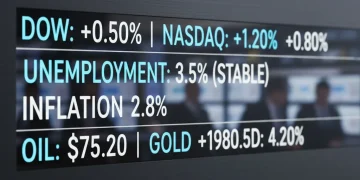
Unemployment Stable at 4.4%: Labor Market Data and Economic Outlook
The stability of the unemployment stable 4.4% rate suggests a resilient but cooling labor market, maintaining wage growth pressures that complicate the Federal Reserve's path toward achieving the 2% inflation target without triggering a deeper economic slowdown.

S&P 500 rotation away from AI stocks: December market shift impact
The S&P 500 experienced a significant rotation away from artificial intelligence stocks in December 2025, shifting investor capital toward value and defensive sectors amid concerns over AI valuation sustainability and macroeconomic headwinds.

Healthcare stocks surge 9.3% as tech retreats: what’s driving the sector rotation
Healthcare stocks rallied 9.3% amid a sector rotation out of technology, which declined 4.8%, reflecting investor reassessment of valuations, interest rates, and defensive positioning in a shifting economic environment.

AI electricity inflation: how data center demand is spiking your power bills
Electricity inflation is accelerating as artificial intelligence data centers demand record amounts of power, pushing grid strain and household energy bills higher. Industry analysts project energy-intensive AI workloads could increase U.S. electricity consumption by 10-15% within five years, creating significant cost pressures for both consumers and utilities.
Healthcare Led Markets with 9.29% Gain in November While Tech Slipped 4.81%
Healthcare equities delivered a 9.29% gain in November as investors rotated into defensive sectors, while technology stocks retreated 4.81%, signaling a significant shift in market leadership and investor risk appetite.
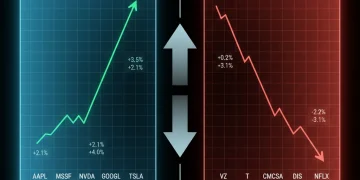
Tech communications divergence: why market split shocked investors
The technology sector's significant outperformance against communications stocks in 2025 reflects structural shifts in AI adoption, valuation dynamics, and interest rate sensitivity rather than temporary market noise.

Surprise Employment Data Shakes Markets: Key Analysis
This week's unexpectedly strong employment report showed 312,000 new jobs versus 180,000 forecast, triggering Treasury yield spikes and equity sell-offs. We analyze the data sources, sector anomalies, and revised Fed rate expectations driving market turbulence.